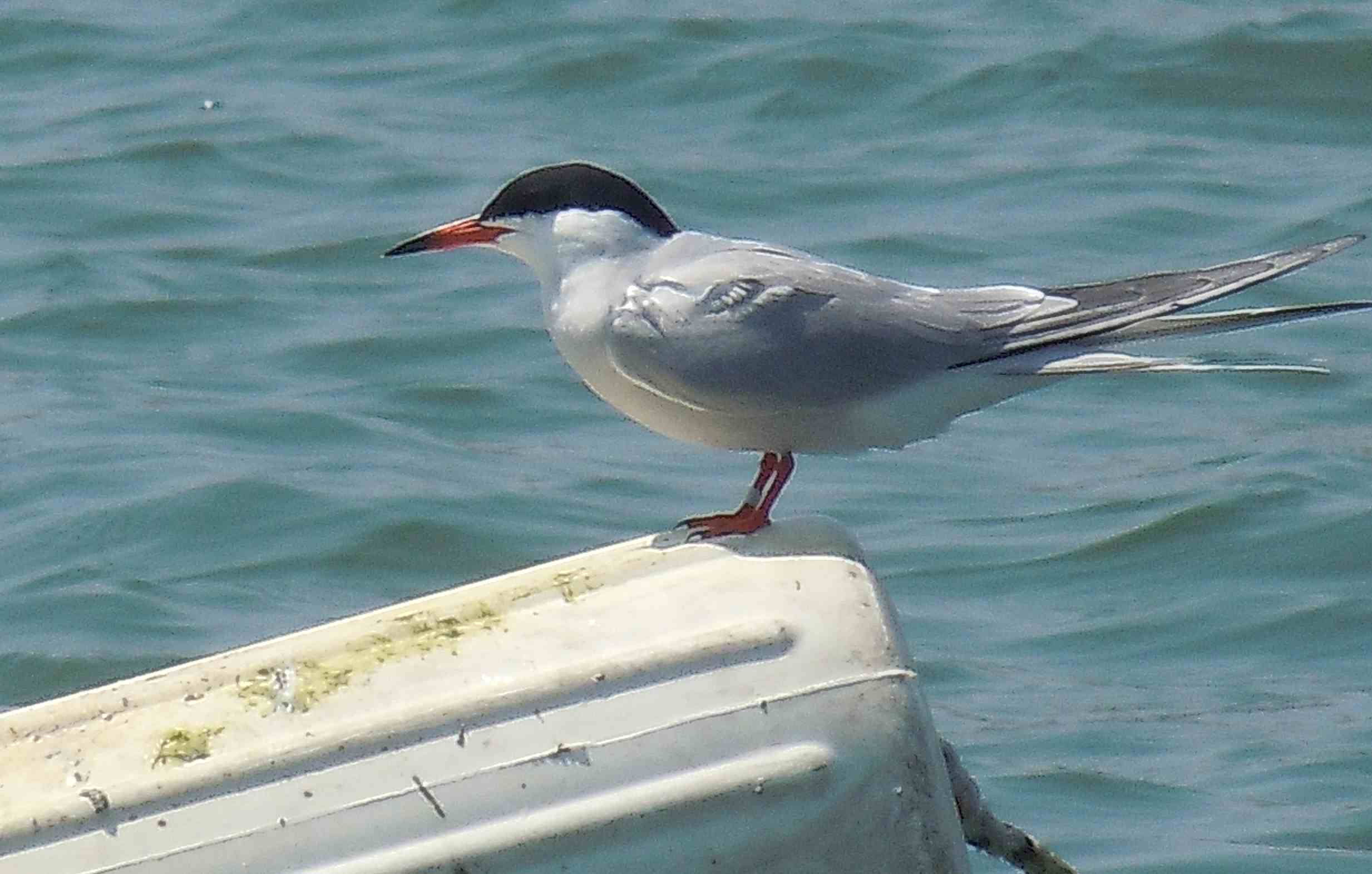
Our 2025 Christmas Bird Count (Audubon) was challenged by a snowy day, frozen binoculars, shorelines covered in fog, and very illusive birds. Starting at 7:30 AM Valerie, Sam, Gary and Hannah surveyed their back yards and bird feeders. Gary’s count of 11 species (including a bully Herring Gull) gave us a boost of encouragement that we might encounter more species during the day, despite the weather conditions.
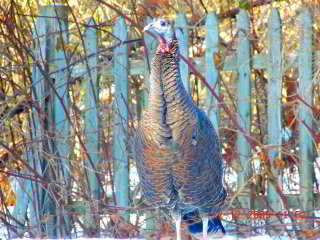
We first focused our efforts on islanders’ bird feeders. On Island Avenue, Bill greeted us as we perused his feeder from the street through binoculars whose lenses were caked with frozen fog and snow. Bill told us several bird stories including one about which species of hawk (Cooper’s, Sharp-shinned, and Goshawk) was better at chasing small birds through bushes. He spends considerable time looking out the window at his feeders, as an alternative to watching TV. In all, we saw 12 species at his feeders, including 6 turkeys.
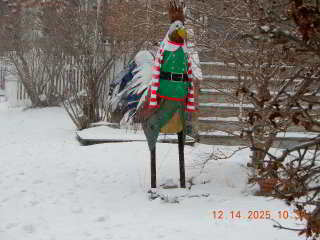
Continuing down Pleasant Street we find Big Cluck the Chicken, inviting us into the Eleanor’s backyard where we stumble upon yet another active bird feeder supporting 6 species including Herring Gulls, Rock Pigeons and a Northern Mockingbird. Heading down Pleasant St we stop at Hannah’s friend Imogen’s house where we find 10 species, including 2 Carolina Wrens, flitting around her many bird feeders.
Onward to Tolman Heights where we often see large numbers of birds of many varieties. This time, we used the Merlin app to help us sort out the chaos of birds darting every which way in a feeding frenzy at Barbara’s well-stocked feeders. We ended up with at least 62 individuals representing 11 species. And there were two more that Merlin had “heard” that we had not seen, including a Golden-crowned Kinglet. The other species was the Common Redpoll, which sometimes visits Maine in winter when seeds in boreal and taiga forests in the subarctic are scarce*. That would have been a real prize, but alas, we were not able to find either of those species.
Scanning the foggy and windy coastal waters of Diamond Passage and the Backshore, we see 9 species including 336 Common Eiders (mostly off Whaleback), 104 Black Scoters, 104 Long-tailed Ducks (mostly flying out of Casco Bay toward Outer Green Island where they roost overnight on the sea), and 26 Buffleheads. On the south shore along Woodlanding Cove we see 48 Canada Geese feeding along the shore. Other waterbirds include Mallards, Black Ducks, Common Goldeneyes, Red-breasted Mergansers and Common Loons. Kathy’s bird feeder near Trout Pond supports a variety of small bird species, including 7 cardinals. As our last stop before dark, we go back to Woodlanding Cove, which affords good views of Cushing Island/Whitehead Cliffs where 29 Great Cormorants gather to roost overnight.
Our final count for the day was 1212 birds belonging to 41 species. Although we did not see several species that we were hoping for, such as Bald Eagle, Hermit Thrush, and Red-throated Loon (seen in 2024), we did well considering the challenging weather conditions.
The Christmas Bird Count, one of the world’s oldest and longest-running citizen science efforts, has been conducted since 1900, and is now managed by the Audubon Society in partnership with other societies around the world. This large-scale monitoring effort enhances our understanding of birds worldwide so that we can better protect them. It also provides insights into the effects of various factors including weather and climate, and human land-use patterns on wildlife species.
By Sam and Patty Wainright
Photos by Patty Wainright
References:
*Vickery, P.D. 2020. Birds of Maine. Princeton University Press.


Acquiring, preserving, and stewarding open space for public use on Peaks Island.